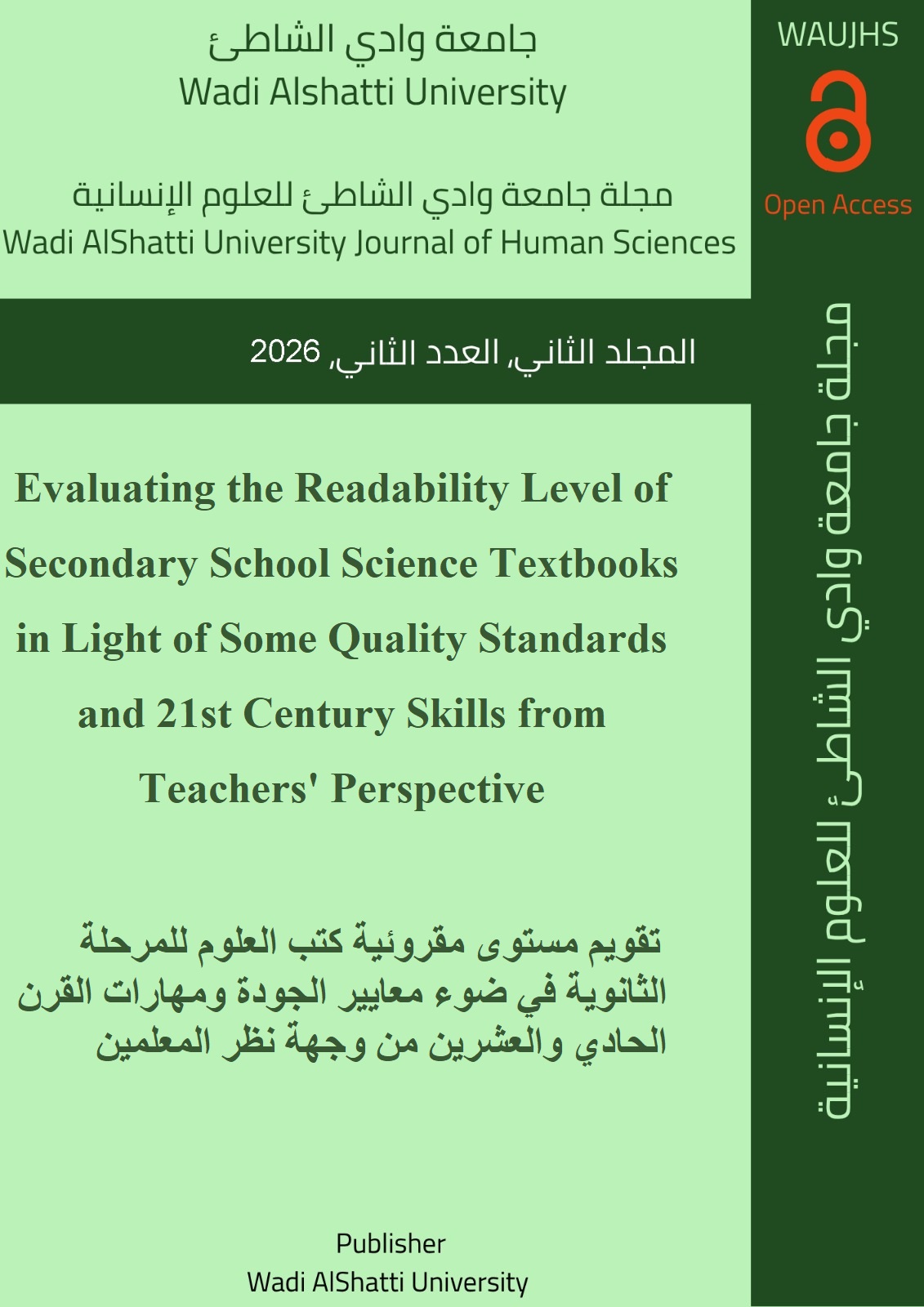
تقويم مستوى مقروئية كتب العلوم للمرحلة الثانوية في ضوء معايير الجودة ومهارات القرن الحادي والعشرين من وجهة نظر المعلمين
DOI:
https://doi.org/10.63318/Keywords:
Equatin Science Textbook Readability, Secondary Science Curricula, Tot Quity Standards, 21st Century SkillsAbstract
This study aimed to evuate the readability level of secondary school science textbooks (Chemistry, Physics, and Biology) in light of tot quity standards, 21st century skills, and self learning from the perspective of teachers. It so examined statistic differences in evuations attributed to demographic and profession variables (gender, academic speciization, teaching experience, and administrative supervisory area) and developed a predictive model for the contribution of textbook dimensions to fostering 21st century skills. The study employed a descriptive anytic approach, sampling )56( secondary science teachers. Data were gathered using a comprehensive 56 item questionnaire structured across seven core dimensions. The instrument demonstrated an exceptionly high level of intern consistency, with a Cronbach's pha coefficient of 0.982. Statistic findings reveed that the overl evuation of textbook readability and quity was at a moderate level, with an overl mean of 3.24 out of 5.00. The dimension of Illustrations and Graphics ranked highest with a high evuation level (3.56), followed by Artistic Quity and Layout (3.25), whereas Readability in Light of 21st Century Skills ranked lowest with a moderate level (3.07). Multiple linear regression anysis confirmed the statistic significance of the overl predictive model, explaining 74.2% of the variance (R2 = .742, F = 23.448, p < .001) in developing 21st century skills. Activities and Accompanying Questions emerged as the primary statisticly significant predictor (β = .411, p = .004). Furthermore, no statisticly significant differences were found in overl readability evuations attributed to gender, academic speciization, teaching experience, or administrative supervisory area. the study recommended prioritizing the architectur design of higher order thinking activities and questions, simplifying complex scientific prose and syntax, and systematicly embedding 21st century competencies and modern science standards throughout secondary science curricula.
Downloads
Published
Issue
Section
License

This work is licensed under a Creative Commons Attribution-NonCommercial 4.0 International License.